



 Access Login


Jun 1, 2026
May 29, 2026
Deepfakes Unmasked: Building Resilience in the Synthetic Media Era
.svg)

.svg)
.svg)
.svg)
Key Takeaways
- Deepfakes Have Become a Business-Critical Risk: Synthetic media now poses material threats to organizations through fraud, executive impersonation, reputational attacks, and misinformation campaigns that can impact operations, finances, and public trust.
- The Trust Problem Is Growing: Advances in generative AI have made it increasingly difficult to distinguish authentic content from fabricated media, creating what the paper describes as a broader erosion of confidence in digital evidence and communications.
- Detection and Authentication Are Becoming Essential Controls: Organizations are increasingly deploying AI-powered detection tools, voice authentication technologies, and content provenance solutions to verify the authenticity of media and communications.
- Regulators Are Moving Toward Greater Transparency: Governments worldwide are developing rules around AI-generated content, with emerging requirements focused on disclosure, authenticity, consent, and accountability for synthetic media.
- Preparedness Requires Governance, Technology, and Training: Effective deepfake resilience depends on integrating synthetic media risks into enterprise risk management, deploying layered detection capabilities, training employees, and establishing rapid-response procedures for suspected incidents.
Deep Dive
Synthetic media, popularly known as deepfakes, has evolved from an internet curiosity into a material operational and security risk. Generative AI now enables adversaries to fabricate videos, voices, and imagery that mimic reality with alarming precision. The implications extend beyond misinformation: deepfakes can erode trust, distort markets, and destabilize democratic institutions.
Corporations must manage reputational exposure, insider impersonation, and AI-driven fraud. Governments face manipulation of electoral processes, disinformation in conflict, and public mistrust of authentic evidence. The ability to authenticate truth in a world of manufactured realism is now a strategic necessity.
The Rising Reality of AI-Powered Synthetic Deception.
Deepfakes sit at the intersection of artificial intelligence, media, and psychology, synthetic artifacts engineered to deceive the senses. They encompass video, audio, imagery, and even text generated by advanced AI models that learn to mimic reality.
Generative Adversarial Networks (GANs) started as research. Deepfakes have evolved through newer architectures such as diffusion models, which can render photorealistic faces and fluid motion with minimal distortion. These systems don’t just copy visual or vocal cues, they understand and recreate patterns of human behavior: the micro-gestures in a politician’s expression, the subtle inflection in a CEO’s tone, or the natural cadence of a newscaster.
- Tools are more sophisticated and mobile than ever. The sophistication of modern tools means a few seconds of source material, a short video clip or a handful of voice samples, can now train an AI model to reproduce a person’s likeness with uncanny realism. The outcome is media that feels authentic, down to the reflection in the eyes or the breath in a sentence. We have entered an era where seeing and hearing are no longer believing. The tools behind these deceptions are no longer confined to research labs. Open-source projects, cloud-based services, and commercial AI platforms now place powerful generative capabilities in the hands of the general public. Many of these tools were designed for legitimate creativity — marketing videos, language localization, entertainment — but the same technology can be repurposed for manipulation at scale.
- Examples abound. Examples of deepfake manipulation are multiplying across every sector and region. Deepfake videos have depicted global leaders “announcing” military surrenders or delivering fabricated policy statements, content designed to provoke confusion, panic, or even diplomatic tension before verification can catch up. Audio clones of senior executives have been used in high-stakes financial scams, with criminals impersonating voices so convincingly that trained employees have authorized multi-million-dollar transfers to fraudulent accounts.
- Democratization of creation is the defining feature of the deepfake era. What once required a Hollywood-grade effects studio can now be achieved by a single user with a laptop. The cost is near zero, the skill threshold, minimal. Meanwhile, the realism of synthetic content continues to improve faster than the defenses designed to detect it. The boundary between the authentic and the artificial is dissolving — and with it, the foundation of visual and auditory trust that institutions rely on.
The New Frontier of Digital Fraud and Misinformation
Deepfakes have moved from novelty to necessity on the risk agenda. They are no longer fringe experiments but sophisticated tools capable of deceiving employees, consumers, and entire populations. For corporations and governments, the threat is broad, immediate, and deeply consequential. These risks include:
- Financial Exploitation: Deepfakes are increasingly used for high-stakes fraud and impersonation. A notable 2024 case involved a Hong Kong finance employee deceived by a video call that appeared to include the company’s CFO, resulting in a 25-million-dollar transfer. Synthetic video and voice can now bypass conventional authentication and create the illusion of legitimacy.
- Reputational and Operational Manipulation: False product launches, fabricated CEO statements, and fake brand campaigns can trigger public outrage and market volatility before verification is possible. Internally, AI-generated job candidates and cloned executive voices threaten hiring integrity and communication security, introducing new vulnerabilities into trusted digital channels.
- National and Social Destabilization: Governments face deepfake political ads, speeches, and news reports designed to influence voters or incite unrest. In conflict zones, synthetic videos showing leaders conceding defeat or issuing false commands have been used to undermine morale and public confidence. The deeper danger lies in public doubt itself, as real evidence becomes indistinguishable from forgery.
The most powerful impact of deepfakes is not just deception but doubt. As synthetic media grows more convincing, the public’s ability to trust authentic information erodes. The challenge for institutions is twofold: stopping malicious use while preserving confidence in legitimate communication. Success will depend on awareness, technology, and governance that keep truth verifiable in a synthetic world.
AI Innovation is Fueling the Rise of Synthetic Reality.
The race to identify and counter deepfakes is now as critical as the technologies that create them. As synthetic media grows more sophisticated, detection has become a cornerstone of digital trust. Organizations across finance, defense, and communications are investing heavily in systems that can separate real from fake in seconds and at scale. This technology includes:
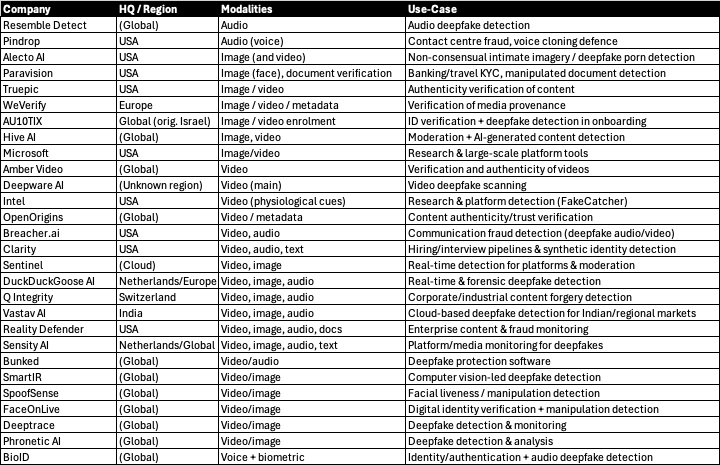
- Multimodal AI Detection: Advanced systems analyze images, videos, and audio simultaneously to uncover inconsistencies invisible to the human eye. Platforms such as Reality Defender and Sensity AI use machine learning models trained on millions of examples to flag synthetic artifacts in real time and assign authenticity scores.
- Voice and Audio Authentication: Specialized tools focus on the rising threat of voice cloning. Vendors like Pindrop and Resemble Detect examine acoustic patterns, tone shifts, and spectral fingerprints to identify manipulated speech and prevent impersonation in call centers and corporate communications.
- Provenance and Forensic Verification: Beyond detection, provenance technologies establish trust at the source. Solutions from Truepic and OpenOrigins embed cryptographic metadata into media files, enabling traceable proof of origin and an unbroken chain of authenticity that can withstand legal and public scrutiny.
The defense ecosystem is maturing quickly but must evolve faster than the technology it guards against. The goal is no longer just catching fakes after the fact but embedding authenticity checks into every stage of digital communication.
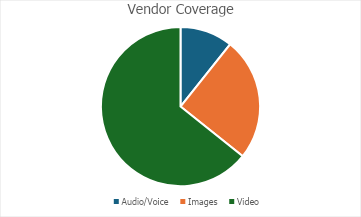
In the age of synthetic content, verifiable truth is becoming a strategic asset—and the next frontier of cybersecurity. Specialized vendors are emerging with distinct approaches:
The escalating contest between deepfake creation and detection defines the modern information landscape. Each new advance in generative realism—more natural expressions, refined lighting, or convincing voice synthesis—immediately triggers innovations in authenticity verification. Detection tools now use neural networks to spot microscopic inconsistencies in pixels and sound, yet generative models quickly adapt, learning to conceal those very traces. This constant leapfrogging is shrinking the gap between what is real and what is fabricated. In this arms race, maintaining trust demands continuous adaptation, layered defenses, and a commitment to verifying truth as rigorously as we create it.
Governments are Racing to Regulate Synthetic Media.
Governments around the world are moving quickly to respond to the rise of synthetic media. What began as niche technological curiosity has evolved into a global policy priority touching national security, elections, and privacy. Regulators are now racing to define how authenticity, consent, and accountability will be governed in an era where artificial content can shape public perception in seconds. Key areas of policy acceleration includes:
- European Frameworks for Transparency: the European Union’s AI Act has established the most comprehensive approach to date. It requires clear labeling of AI-generated content and restricts manipulative or deceptive uses. By treating synthetic media as a matter of digital consumer protection, Europe is setting a global benchmark for transparency and accountability.
- U.S. State and Federal Action: in the United States, deepfake regulation is developing through both state-level and federal initiatives. States such as California, Texas, and New York have passed laws addressing election-related deepfakes and non-consensual explicit content. Federally, the proposed Take It Down Act seeks to criminalize the creation and distribution of sexually explicit synthetic imagery and establish clearer recourse for victims.
- Asia-Pacific Governance Models: Governments in Singapore, Japan, and India are crafting frameworks that balance innovation with responsibility. These include disclosure rules for AI-generated material, requirements for digital provenance tracking, and penalties for malicious creation or distribution. The region’s focus is on practical governance—maintaining public trust without stifling technological progress.
The global policy environment for synthetic media is still forming, but the direction is unmistakable. Regulation is shifting from reactive to preventive, emphasizing transparency, consent, and authenticity. As deepfakes become more sophisticated, the defining challenge for lawmakers will be keeping pace with technology while safeguarding both innovation and truth.
Organizational Readiness
Forward-thinking organizations are beginning to recognize that defending against deepfakes is not just a technical issue but a core element of cybersecurity, risk management, and brand protection. As synthetic media threats grow more sophisticated, readiness depends on the ability to detect, respond, and communicate with precision under pressure.
Core Elements of Deepfake Preparedness
- Awareness and Governance: Organizations are embedding synthetic media risk into enterprise risk frameworks and leadership training. Executives, communications teams, and public-facing staff are learning to identify manipulated content, verify authenticity, and coordinate with security and legal teams before misinformation spreads.
- Technical Integration: Automated detection systems are being deployed across communication channels, human resources, and social media monitoring. Some organizations are adopting watermarking and digital signature technologies to authenticate official statements, videos, and images before release, ensuring content integrity from the source.
- Incident Response and Recovery: Rapid verification and response protocols are now essential. Enterprises are developing crisis playbooks that define how to verify suspect content, manage public messaging, and collaborate with forensic labs or detection vendors. The objective is not just exposure but containment—stopping reputational and financial damage before it scales.
True resilience against deepfakes is built on preparedness, not reaction. By combining governance, technology, and communication discipline, organizations can preserve credibility even when confronted with highly convincing synthetic deception. The capacity to prove authenticity will soon define both institutional trust and strategic strength.
Case Studies
Real-world incidents have already shown how deepfakes can translate digital deception into financial loss, political disruption, and reputational damage. These examples highlight the speed, scale, and impact of synthetic media when detection and response systems are not yet mature. Real life impacts include:
- Financial Fraud via Deepfake Video Call (2024): A multinational corporation’s finance team was deceived by a synthetic video conference that appeared to include their CFO. The impostor requested an urgent fund transfer, complete with realistic facial movement, voice cloning, and natural background cues. The result was a loss exceeding 25 million dollars and a subsequent overhaul of the company’s verification and communication protocols.
- Election Manipulation in Europe (2024): During a regional campaign, an audio deepfake surfaced that falsely portrayed a political candidate making inflammatory statements. The recording circulated rapidly through encrypted messaging apps before forensic experts could intervene. The fallout spurred new legislation requiring clear disclosure of AI-generated political content and accelerated election-monitoring reforms.
- Brand Defamation Attack (2023): A global consumer goods company became the target of a deepfake advertisement that placed its logo in a divisive political message. Within 24 hours, the video amassed millions of views and triggered a consumer backlash. Even after forensic confirmation that the clip was synthetic, the brand faced weeks of reputational recovery and media scrutiny.
These cases demonstrate that deepfakes are not abstract risks—they are operational and strategic threats capable of moving markets, influencing voters, and undermining institutional credibility. Each event underscores the same lesson: rapid detection and decisive communication are no longer optional; they are essential defenses in the age of synthetic reality.
Recommended Actions for Institutional Readiness
To counter the accelerating risks posed by synthetic media, organizations and public institutions must move from awareness to action. The deepfake threat is no longer theoretical—it’s operational, scalable, and fast-moving. Effective response requires embedding resilience into governance, technology, and culture simultaneously.
- Institutionalize Deepfake Risk Management: Integrate synthetic media threats into enterprise risk frameworks, compliance functions, and board-level oversight. Deepfake detection should sit alongside cybersecurity, fraud prevention, and brand protection as a core governance concern. Establish accountability pathways including designated leads for content authenticity and escalation protocols.
- Adopt Layered Detection Systems: No single tool is sufficient. Combine automated AI screening, manual verification, and content provenance technologies (such as watermarking or metadata tagging). This layered approach ensures that suspicious content is flagged early and verified accurately before it spreads.
- Build Strategic Vendor Partnerships: The detection landscape evolves as quickly as the threat itself. Form partnerships with specialized vendors and academic labs to access the latest detection algorithms and intelligence feeds. Establish contractual frameworks for ongoing updates and interoperability across systems.
- Train Leadership and Staff for Digital Verification: Equip employees from executives to entry-level staff—with training to recognize signs of manipulation across video, audio, and text. Empower leaders to validate communications through secure channels, reducing the likelihood of fraud, misinformation, or reputational harm.
- Develop Rapid-Response Communication Playbooks: Create predefined workflows for responding to suspected synthetic incidents. This includes internal escalation, external messaging, and collaboration with law enforcement or media platforms. The ability to respond within hours can prevent days of reputational damage.
- Engage in Standards and Policy Formation: Participate actively in industry and regulatory efforts to establish shared norms around authenticity labeling, content provenance, and accountability. Influence emerging standards to ensure they are practical, enforceable, and globally interoperable.
The Road Ahead
Deepfakes are not a temporary digital nuisance, they represent a permanent shift in how truth and evidence function in society. As generative AI becomes embedded in communication, marketing, and governance, the ability to prove authenticity will become a foundational element of organizational credibility.
Corporations and governments that treat authenticity as infrastructure—deploying detection tools, provenance systems, and ethical guidelines—will lead in resilience and trust. Those that delay will face not only financial and reputational risk but the erosion of their most vital asset: belief in their reality.
The GRC Report is your premier destination for the latest in governance, risk, and compliance news. As your reliable source for comprehensive coverage, we ensure you stay informed and ready to navigate the dynamic landscape of GRC. Beyond being a news source, the GRC Report represents a thriving community of professionals who, like you, are dedicated to GRC excellence. Explore our insightful articles and breaking news, and actively participate in the conversation to enhance your GRC journey.
🔒
Continue reading with Access
Get full access to this analysis and everything else on GRC Report—enforcement databases, custom alerts, and market intelligence.
Get Access →
Already a member?
Sign In
Cancel anytime
Full archive access
Custom alerts
Sponsored by
