



Apr 28, 2025
May 4, 2026
Dynamic Organizational Dimension Modeling: Because “Winging It” Doesn’t Scale
.svg)

.svg)
.svg)
.svg)
Key Takeaways
- From Static to Dynamic Operating Models: Dynamic Organizational Dimension Modelling (DODM) replaces rigid organizational structures with continuously updating models that reflect real-time changes in roles, processes, and accountability.
- Context-Driven Decision Making: By embedding organizational context into data, governance, and analytics, DODM enables insights that are aligned with how the business actually operates at any given moment.
- Adaptive Governance and Risk Alignment: Governance, risk, and compliance frameworks evolve automatically with organizational changes, ensuring ownership, controls, and risk visibility remain accurate and synchronized.
- Enterprise-Wide Integration Layer: DODM functions as a core architectural layer across data, content, processes, and analytics, transforming siloed systems into a unified, responsive ecosystem.
- Foundation for Self-Learning Organizations: When fully implemented, DODM enables Dynamic Organizational Intelligence, allowing enterprises to continuously learn, adapt, and optimize in response to change.
Deep Dive
In today’s enterprise, change behaves less like a calendar event and more like a weather pattern that refuses to settle down. Markets shift faster than strategies can catch up, teams appear and disappear like pop-up shops, and regulators rewrite the rules just as everyone finishes reading the old ones. Yet most organizations are still using management models that behave like they live in a museum. Reports, governance frameworks, and analytics engines were built for a world where “change management” meant an annual meeting, not a daily lifestyle.
Dynamic Organizational Dimension Modelling, or DODM, enters the scene like the adult in the room who also happens to know how to code. It allows an enterprise to continuously model and adapt its own DNA—structure, processes, roles, policies, and performance metrics—in real time. Instead of freezing the organization into a tidy PowerPoint chart that goes out of date before the ink dries, DODM creates a living, breathing representation that evolves along with reality.
At its core, DODM is the organizational equivalent of a self-updating map. When a new business unit forms, when leadership shifts, or when policy owners suddenly find themselves responsible for something new, the model reflects it instantly. Analytics, governance, and performance tracking adjust on their own, keeping every system aligned with what the enterprise actually looks like, not what it looked like three reorganizations ago. The result is an organization that finally stops chasing its own tail and starts seeing itself as it truly is—dynamic, interconnected, and constantly rewriting the rules of how it works.
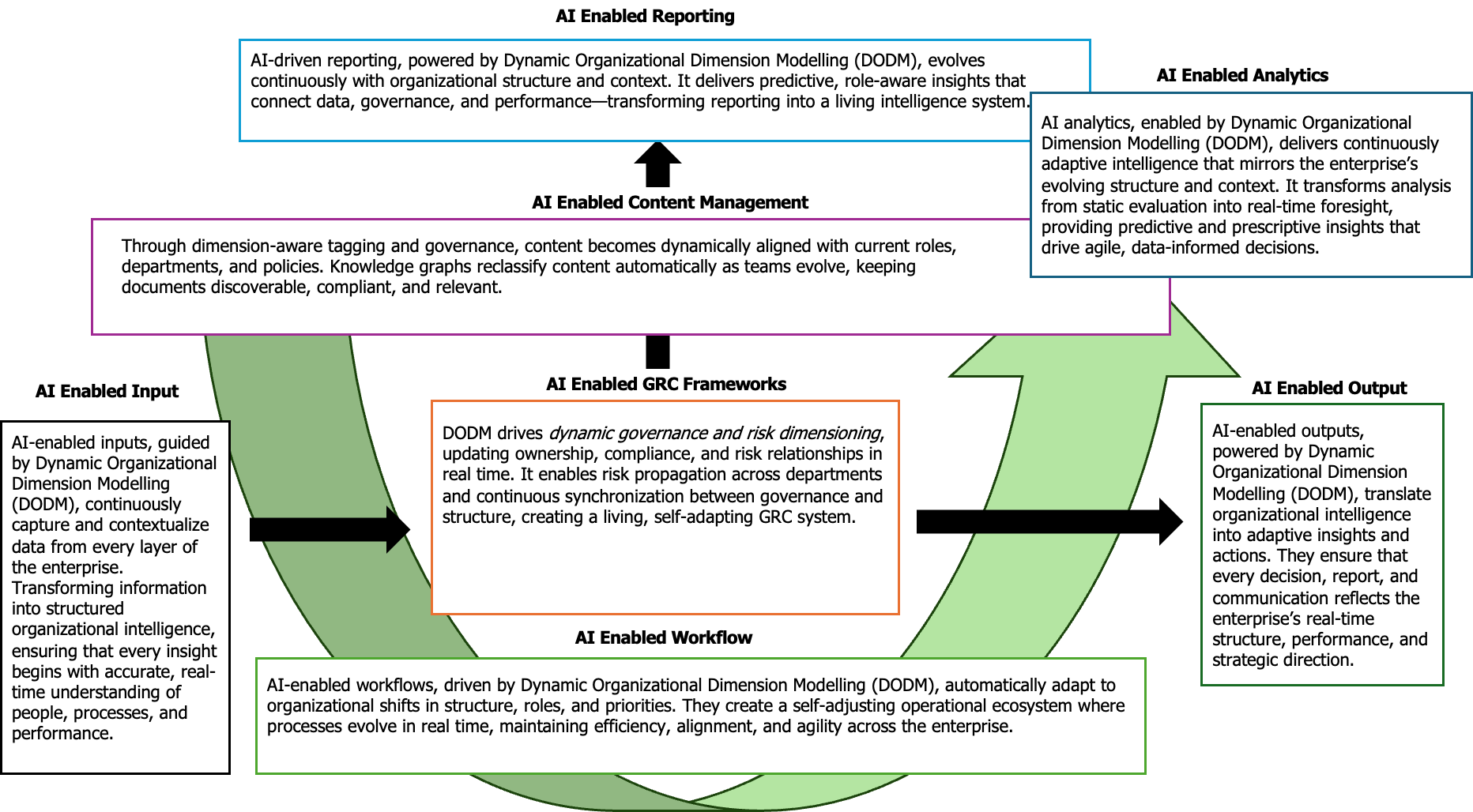
Equally significant is DODM’s ability to infuse context into every layer of enterprise intelligence. By mapping the relationships between people, processes, and outcomes, it provides a multi-dimensional, role-aware understanding of how work gets done and how value is created. Decision-makers gain insights that are not only data-driven but also situationally grounded, enabling actions that are timely, relevant, and strategically coherent. Ultimately, Dynamic Organizational Dimension Modelling enables a shift from rigid hierarchy to adaptive intelligence. It transforms the enterprise into a system that learns and reorganizes itself continuously, guided by data and informed by experience. In doing so, it lays the foundation for a truly responsive organization—one that can anticipate change, align its structure to opportunity, and sustain agility at scale.
Integration Architecture Not Capability
Dynamic Organizational Dimension Modelling is most powerful when it is not treated as a separate capability, but rather as an architectural layer that permeates every function of the intelligent enterprise. It integrates seamlessly across data, content, governance, process automation, and analytics, transforming each layer from a static construct into a living system that reflects the true state of the organization.
At the foundation of this architecture lies the data layer, where DODM introduces organizational metadata ingestion and dimension mapping. Traditional data ingestion pipelines capture transactions, events, and metrics, but often lack the contextual understanding of how these data points relate to people, teams, and ownership structures. By extending these pipelines to include organizational hierarchies, roles, functions, geographies, and accountability relationships, DODM allows datasets to become enriched with the living structure of the enterprise. When teams reorganize or business units evolve, adaptive schema evolution ensures that the underlying data model adjusts automatically. The result is a foundation where data is not only clean and validated but also deeply contextualized and ready for dynamic analytics.
In content management, DODM introduces a new level of intelligence through dimension-aware tagging and governance. By embedding organizational context into the knowledge graph, content can be automatically classified according to its relevance and ownership within the enterprise. Documents and policies naturally realign when structures change, ensuring that each piece of content remains discoverable, compliant, and aligned to current responsibilities. Lifecycle management becomes fluid, adapting automatically as teams form, merge, or pivot to new strategic priorities.
Within governance, risk, and compliance frameworks, the influence of DODM is even more profound. Traditional GRC systems are static, assigning ownership and accountability once, and then struggling to keep up with the realities of organizational change. By integrating dynamic governance and risk dimensioning, DODM allows risk ownership, compliance responsibilities, and control mechanisms to evolve continuously in alignment with shifting structures. It enables the propagation of risk across dimensions so that a change in one department triggers a recalibration of potential impacts across others. The result is a GRC framework that is self-adaptive and continuously synchronized with the organization’s living architecture.
Process automation also benefits significantly from the integration of DODM. When embedded into orchestration tools, it provides a mechanism for workflows to adapt automatically to organizational shifts. Tasks reroute seamlessly when departments merge or new leadership structures emerge, ensuring that operations never lose momentum. Processes can be prioritized dynamically based on current organizational capacity and strategic importance. Coordination across functions becomes naturally adaptive, eliminating the need for costly manual workflow redesign and creating a system that evolves as fast as the enterprise itself.
At the insights and reporting level, DODM establishes a dimensionally adaptive analytics layer that ensures intelligence is always organization aware. Dashboards and analytic models can now be sliced and interpreted by dimensions such as business unit, geography, function, or risk owner, reflecting real-time accountability. Predictive and prescriptive analytics evolve in tandem with changes in organizational context, producing insights that are accurate, timely, and aligned with the enterprise’s living structure. Instead of static hierarchies and outdated metrics, leaders gain a continuously refreshed view of performance and risk that reflects how the business operates today.
Finally, DODM closes the loop through a continuous learning and feedback layer. Insights generated from AI-enabled content management, GRC systems, and automated processes feed back into the DODM engine, enabling organizational simulation and evolution. This allows enterprises to explore the potential impact of structural changes before they happen, testing scenarios such as decentralizing compliance or merging operational functions. Over time, the organization becomes self-reflective, using AI-driven feedback loops to continuously refine governance, content alignment, and process efficiency.
Through this integrated architecture, Dynamic Organizational Dimension Modelling transforms the enterprise into an adaptive organism—one capable of sensing, learning, and evolving continuously. It replaces static structures with living intelligence, ensuring that every part of the organization operates in harmony with its dynamic reality.
The Resulting Meta-Layer: Dynamic Organizational Intelligence
When Dynamic Organizational Dimension Modelling is embedded across every layer of the enterprise, it gives rise to an entirely new capability: Dynamic Organizational Intelligence. This meta-layer represents the convergence of data, content, governance, processes, and insights into a single, continuously adaptive system of intelligence. It transcends traditional boundaries, connecting the structural and operational layers of the enterprise into one coherent and responsive ecosystem.
Dynamic Organizational Intelligence creates an environment where every element of the enterprise communicates seamlessly with the others. Data feeds directly into content management and governance frameworks, which in turn inform automated processes and analytic systems. This integration allows the organization to operate as a unified whole, where decisions are informed not only by information but by context—by an awareness of how people, policies, and performance interact in real time.
At its core, this meta-layer achieves what static systems cannot: genuine alignment between human decision-making and machine intelligence. It enables continuous synchronization between the shifting realities of the organization and the analytical models that describe them. Governance no longer lags behind structural change, and insights no longer depend on outdated hierarchies. Instead, every process, policy, and metric evolves alongside the organization itself, maintaining relevance and precision at every moment.
Dynamic Organizational Intelligence transforms the enterprise into a continuously learning digital twin. This is a self-aware system that mirrors the organization’s living state and anticipates its evolution. This transformation moves the organization beyond automation toward true adaptability, where intelligence is not a function, but a fabric woven throughout the enterprise. The result is a new class of organization: one that learns, aligns, and optimizes itself as naturally as it operates.
Strategic Implications and Path to Implementation
The adoption of Dynamic Organizational Dimension Modelling is not a technological upgrade; it is a strategic transformation that redefines how an enterprise understands and manages itself. It represents a shift from systems of record to systems of intelligence, from governance as a control mechanism to governance as a dynamic capability. To realize its full potential, organizations must treat DODM as both a strategic imperative and an architectural foundation for the next generation of digital enterprise design.
- Establish data and organizational alignment. Successful implementation begins with integrating organizational structure, roles, and accountability metadata into the data foundation. This alignment ensures that every dataset and process reflects the current reality of how the business operates. It creates a living, traceable map of relationships between people, policy, and performance—a prerequisite for real-time intelligence. Organizations that treat structure as a data dimension rather than a static chart will unlock entirely new forms of transparency and adaptability.
- Embed DODM within core enterprise functions rather than layering it as an isolated capability. Governance, risk, compliance, and content management systems must evolve together under a shared dynamic model. By doing so, enterprises replace disjointed reporting and oversight with a unified, contextualized intelligence ecosystem. This approach allows compliance and performance frameworks to self-adjust as structures, markets, and priorities evolve, dramatically reducing the latency between decision and action.
- Adopt AI-driven orchestration as a strategic enabler. When DODM informs intelligent automation, processes no longer depend on manual redesign to stay relevant. Workflows adjust automatically as the organization changes, preserving agility and minimizing disruption. This creates a state of operational resilience where agility is not an exception managed through crisis, but a continuous property of how the enterprise functions.
- The strategy also requires a deliberate focus on cultural and leadership transformation. Dynamic intelligence is only as effective as the willingness of leaders to operate in transparency and trust. Traditional management models, rooted in control and hierarchy, must give way to ecosystems of accountability and adaptive governance. Leadership must evolve from directing activity to enabling continuous learning across human and digital teams. The role of the executive shifts from oversight to orchestration—guiding the enterprise as a living system that senses, learns, and adapts in real time.
- The strategic path must include measurement and iterative scaling. Organizations should begin by identifying high-value domains—such as regulatory reporting, risk alignment, or enterprise analytics—where DODM can deliver immediate, measurable benefit. Early successes build momentum, establish governance confidence, and create data feedback loops that accelerate broader adoption. Over time, DODM becomes the connective tissue across business functions, enabling predictive insight, adaptive compliance, and synchronized decision-making at scale.
The GRC Report is your premier destination for the latest in governance, risk, and compliance news. As your reliable source for comprehensive coverage, we ensure you stay informed and ready to navigate the dynamic landscape of GRC. Beyond being a news source, the GRC Report represents a thriving community of professionals who, like you, are dedicated to GRC excellence. Explore our insightful articles and breaking news, and actively participate in the conversation to enhance your GRC journey.
🔒
Continue reading with Access
Get full access to this analysis and everything else on GRC Report—enforcement databases, custom alerts, and market intelligence.
Get Access →
Already a member?
Sign In
Cancel anytime
Full archive access
Custom alerts
Sponsored by
