



 Access Login



Jul 12, 2024
Nov 23, 2026
The Governance Gap: Financial Firms Are Deploying AI Faster Than They Can Control It


Key Takeaways
- AI Adoption Is Outpacing Oversight: A 2024 Bank of England and FCA survey found that 75% of UK financial firms were using AI, but 46% reported only a partial understanding of the systems they deployed.
- Third-Party AI Creates Governance Blind Spots: AI embedded in vendor software and cloud services can fall outside traditional model inventories, leaving firms exposed to risks they may not be adequately monitoring or validating.
- AI Agents Require Stronger Identity Controls: Autonomous AI agents introduce new non-human identities that require defined ownership, restricted permissions, continuous monitoring, and auditable activity.
- Regulatory Changes Demand Continuous Governance: Phased implementation of the EU AI Act and increased third-party oversight under DORA reinforce the need for recurring control testing, policy reviews, and board reporting.
- Existing Governance Practices Offer a Starting Point: Firms can address these gaps by extending established inventory, due diligence, identity management, and risk assessment processes to vendor AI and autonomous agents.
Deep Dive
AI is arriving in financial firms through vendors, agents, and staged regulation faster than most control frameworks were built to handle. Three gaps stand out, and each can be closed with work governance teams already know how to do.
The Gap in Numbers
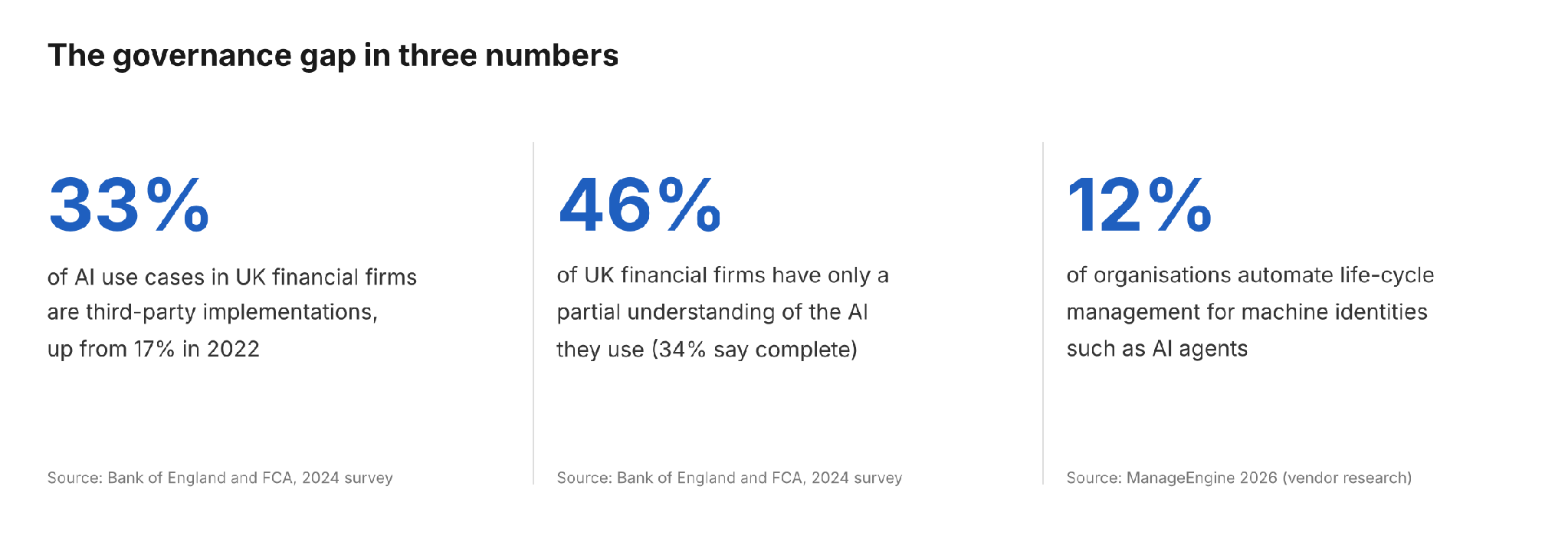
Most financial firms now use AI. Far fewer fully understand it. In the Bank of England and FCA's 2024 survey of 118 UK financial firms, 75% were already using AI. But 46% said they had only a partial understanding of the AI they use, against 34% who claimed complete understanding.
The regulators traced much of that gap to where the AI comes from. A third of all AI use cases were third-party implementations, up from 17% in the 2022 survey. Understanding was higher for models built in-house and lower for those bought in.
That is the governance gap in one sentence. Firms are deploying AI faster than their control frameworks can see it. Over the past year, I have tracked where that gap is turning into budgeted work for risk, compliance, and security teams. Korim's Q4 2026 brief, The Governance Gap, ranked ten areas of AI and financial compliance work. Three came out clearly ahead, and each is backed by independent data.
The governance gap: financial firms are deploying AI faster
Gap 1: Third-Party AI Sits Outside the Model Inventory
Most model risk frameworks were written for models a bank builds itself. Today, AI increasingly arrives inside vendor software, cloud services, and data feeds. It often never reaches the model inventory, so it is never tiered, validated, or reported to the board.
Concentration makes this worse. The same Bank of England and FCA survey found the top three providers accounted for 73% of cloud services and 44% of AI models that firms reported. A weakness in one vendor's model can sit inside dozens of firms at once.
The fix is familiar work applied to a new category:
- Inventory everything, including AI embedded in vendor products, not just models built in-house.
- Tier by risk and set a third-party AI due diligence standard for procurement and renewals.
- Take it to the board with an updated model risk policy that names vendor AI explicitly.
- Set a review cadence so vendor models are revalidated when they change, not just when they are bought.
Gap 2: AI Agents Are Identities, and Few Firms Manage Them as Such
An AI agent that acts on a firm's behalf needs credentials. It reads customer data, calls systems, and can trigger transactions. In control terms, every agent is a new non-human identity with permissions to scope, test, and audit.
Most identity programs are not ready for that. In ManageEngine's Identity Security Outlook 2026, a survey of 515 identity and security leaders in the US and Canada, nearly half reported more than 100 machine identities for every human one. Only 12% had automated life-cycle management for machine identities. The survey is cross-sector and comes from a vendor that sells identity tools, so treat it as directional for banks. But the direction is clear.
The cost of getting this wrong is already forecast. Gartner expects more than 40% of agentic AI projects to be canceled by the end of 2027, citing escalating costs, unclear business value, and inadequate risk controls. Controls are the part of that list a governance team can fix. Give every agent a named owner, scoped permissions, tested limits, and a complete audit trail before it goes live.
Gap 3: Rules Are Arriving in Stages, So Governance Has to Recur
The regulatory timetable rewards continuous governance over one-off projects. In the EU, the AI Act's obligations for stand-alone high-risk systems, a category that includes credit scoring, now apply from December 2, 2027, under the Digital Omnibus agreement reached in May 2026. That was originally due in August 2026. Treat the delay as a defined runway, not a reason to wait.
Third-party oversight is tightening in parallel. In November 2025, the European Supervisory Authorities designated 19 critical ICT third-party providers under DORA, bringing them under direct EU oversight. Designation does not move responsibility. The regulated firm still owns its third-party risk. The UK's critical third parties regime is expected to follow a similar approach.
When rules land in stages, a single compliance project goes stale quickly. What holds up is a recurring cycle of quarterly control testing, policy updates as rules change, and an oversight pack the board and supervisors can rely on.
Where to Start: Assess, Implement, Then Review on a Cycle
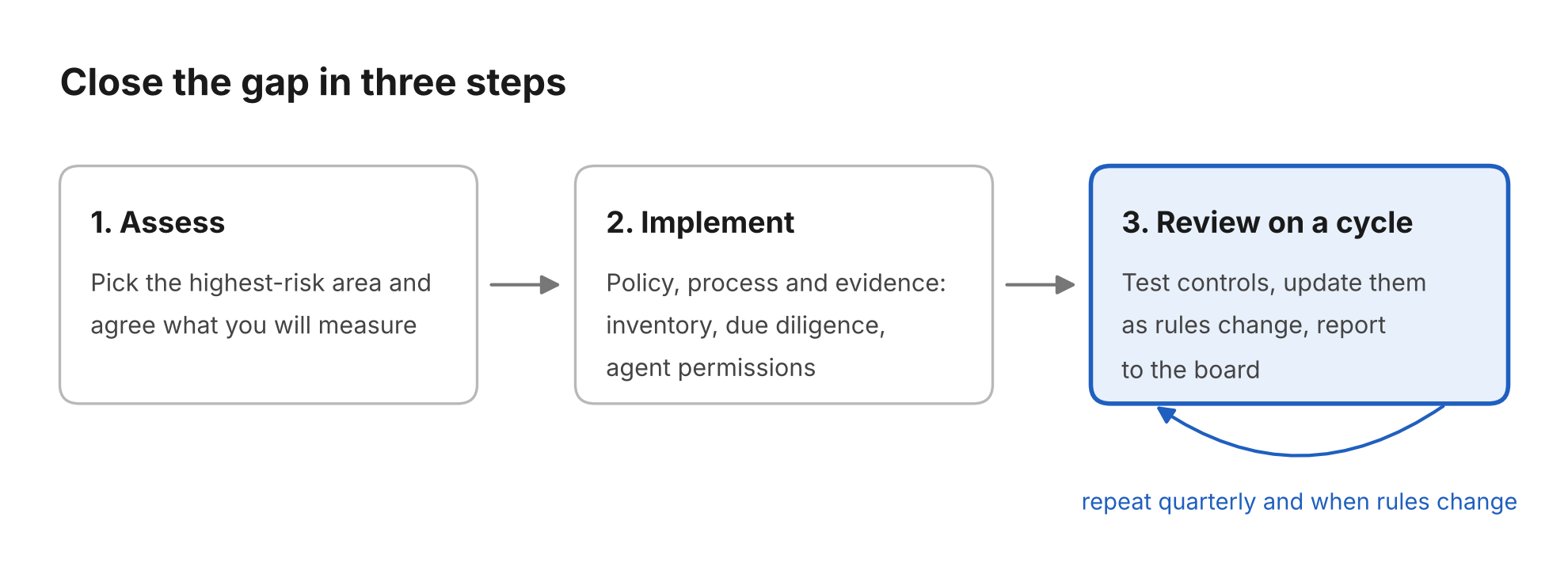
None of these gaps needs a transformation program to close. A practical sequence has three steps.
- A defined assessment. Pick the highest-risk area, such as the five vendor AI tools touching customer decisions or the agents with write access to core systems. Agree up front what you will measure: the share of AI use cases in the inventory, the vendor tools with completed due diligence, or the agents with a named owner and tested permissions.
- Implementation. Turn the findings into policy, process, and evidence: the updated model risk policy, the due diligence standard, and the permission model for agents.
- Recurring control reviews. Test the controls on a fixed cycle, update them as rules change, and report to the board in a consistent format.
The third step is where most programs fall down. AI vendors focus on deployment, and few stay to test controls as models, rules, and use cases change. That continuing work has to sit somewhere, whether that is an in-house team, a second-line function, or an outside reviewer on retainer.
For boards, the gap comes down to three questions. Do we know every AI system we rely on, including those inside vendor products? Does every AI agent have an owner, scoped permissions, and an audit trail? And when the rules change next, who retests our controls?
What This Does Not Mean
The evidence is uneven, and it is worth being clear about where.
Investor interest is not buyer demand. Korim's data records $1,187 million across 13 funding rounds in its AI governance theme. That shows capital and competition among tool vendors. It does not prove that firms are buying.
Some of the regulation is still moving. Dates have already slipped once under the AI Act, and other areas, such as tokenized securities and stablecoin rules, are still being finalized. Confirm dates with counsel before building a program around them.
Survey data has limits. The Bank of England and FCA survey dates from 2024, and the identity data is cross-sector and vendor-published. Both point the same way, but firms should test them against their own inventories.
Close the Gap Before the Rules Do
AI will keep arriving faster than rules can be written. Firms that wait for final regulation will be governing systems they already depend on and only partly understand. The work is not exotic: inventory, ownership, permissions, testing, and reporting. What is new is applying it to vendor AI and autonomous agents, and doing it on a cycle rather than once.
The governance gap is real, but it is closable. The firms that close it first will spend less time explaining to their boards and supervisors why they could not see what their AI was doing.
Methodology Note: The Korim Brief (Vendor Research)
The Governance Gap (Q4 2026 edition) was produced by Korim, which the author owns. It ranks ten opportunities in AI controls and financial compliance drawn from the Korim Signal Index, which aggregates market data and compares sector demand against disclosed funding.
Each opportunity is backed by up to five types of evidence: Index opportunities, Index metrics (capital evidence, not buyer demand), practitioner network signals (stated expectations, not commitments), Korim's own hypotheses (not independent corroboration), and disclosed funding (evidence of competition, not demand).
Each was scored by analysts on strength of evidence, consulting fit and budget clarity, and speed to a first paid engagement. Scores are judgments, not measured market sizes.
Public sources were accessed in October 2026. Sample: 300+ Index opportunities and signals reviewed.
All statistics in this article come from the independent sources below except the AI governance funding total, which is a Korim Index figure.
The GRC Report is your premier destination for the latest in governance, risk, and compliance news. As your reliable source for comprehensive coverage, we ensure you stay informed and ready to navigate the dynamic landscape of GRC. Beyond being a news source, the GRC Report represents a thriving community of professionals who, like you, are dedicated to GRC excellence. Explore our insightful articles and breaking news, and actively participate in the conversation to enhance your GRC journey.
Sponsored by

